
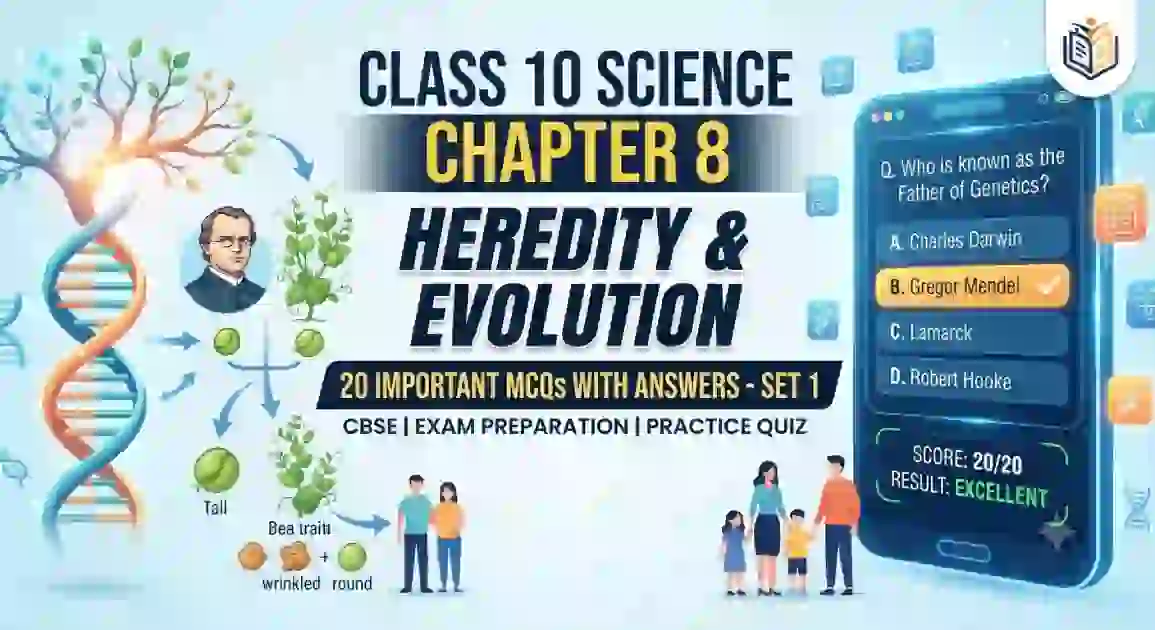
Class 10 Science Chapter 8 MCQs with Answers | Heredity and Evolution Important Questions Set 1
Class 10 Science Chapter 8 MCQs with Answers – Heredity (Set 1)
Prepare for your CBSE Class 10 Science examination with this free online quiz featuring 20 important Class 10 Science Chapter 8 MCQs on Heredity. Test your knowledge, practise important concepts and check your understanding with answers and explanations.
This Heredity MCQ practice set is designed to help students revise important topics, understand genetic inheritance and prepare for school examinations.
Class 10 Science Chapter 8 Online Quiz – Heredity
Attempt this free Class 10 Science Chapter 8 online quiz and check how well you understand the chapter.
Quiz Details:
- Subject: Science
- Class: 10
- Chapter: 8 – Heredity
- Total Questions: 20
- Quiz Type: Multiple Choice Questions
- Purpose: CBSE Exam Preparation
- Difficulty: Practice Level
Start the quiz below and try to answer all 20 questions.
[PASTE YOUR EXISTING QUIZ SHORTCODE HERE]
Important Topics Covered in Class 10 Heredity MCQs
The following concepts are important for understanding heredity and solving Class 10 Science Chapter 8 questions.
1. Heredity
Heredity is the process through which characteristics are passed from parents to their offspring. These inherited characteristics may include features such as eye colour, hair type and other biological traits.
2. Genes and DNA
Genes are specific segments of DNA that contain information influencing inherited characteristics. DNA carries genetic information from one generation to the next.
3. Gregor Mendel and Genetics
Gregor Johann Mendel is widely known as the Father of Genetics. His experiments on pea plants helped establish important principles of inheritance.
4. Dominant and Recessive Traits
A dominant trait can be expressed even when only one copy of the corresponding dominant allele is present. A recessive trait generally appears when both copies are recessive.
5. Sex Determination in Humans
In the typical human chromosomal pattern, females have XX chromosomes and males have XY chromosomes. The mother contributes an X chromosome, while the father contributes either an X or a Y chromosome. This combination usually results in XX or XY.
Important Class 10 Science Chapter 8 Questions and Answers
Revise these sample questions before attempting the complete quiz.
Q1. What is heredity?
Answer: Heredity is the transfer of characteristics from parents to offspring.
Q2. Who is known as the Father of Genetics?
Answer: Gregor Johann Mendel.
Q3. What is a gene?
Answer: A gene is a segment of DNA that carries genetic information and influences inherited characteristics.
Q4. Which parent’s chromosome contributes to the typical XX or XY sex chromosome combination in humans?
Answer: The father’s sperm contributes either an X or a Y chromosome, while the mother’s egg contributes an X chromosome.
How to Prepare for the Heredity Chapter
Follow these preparation tips to improve your understanding and performance:
- Read the NCERT chapter carefully and understand the important definitions.
- Revise Mendel’s experiments and the basic principles of inheritance.
- Understand the difference between dominant and recessive traits.
- Practise MCQs regularly to identify topics that need more revision.
- Review incorrect answers and understand why the correct option is right.
Benefits of Practising Class 10 Heredity MCQs
- Helps revise important chapter concepts.
- Improves understanding of genetic inheritance.
- Provides practice with objective-type questions.
- Helps identify weak topics before examinations.
- Supports preparation for CBSE Class 10 Science exams.
Frequently Asked Questions (FAQs)
Class 10 Science Chapter 8
Q1. How many questions are included in this Class 10 Science Chapter 8 quiz?
This practice quiz contains 20 multiple-choice questions on Heredity.
Q2. Is this Heredity MCQ quiz free?
Yes, students can use this online practice quiz for free.
Q3. Is this quiz useful for CBSE Class 10 Science preparation?
Yes, it provides practice on important Heredity concepts and objective-type questions for revision.
Q4. Can I practise more Class 10 Science MCQs?
Yes, explore other chapter-wise and subject-wise Class 10 Science mock tests available on Student Mock Test.
Explore More Free Mock Tests
Continue your exam preparation with more practice tests:
- Class 10 Science Mock Tests
- Class 10 Science Chapter 7 MCQs
- Class 10 Science Chapter 8 Heredity MCQs – Set 2
- Class 10 Maths Mock Tests
- Free Online Mock Tests for Students
Practise regularly, revise your mistakes and improve your preparation with StudentMockTest.com.
FAQ
Q1. What is heredity?
Transfer of traits from parents to offspring.
Q2. Who is the father of genetics?
Gregor Mendel.
Q3. What is a gene?
A segment of DNA controlling traits.
Q4. What determines the sex of a child?
The father’s chromosome (X or Y).
Class 10 Science Chapter 8 MCQs Class 10 Science Chapter 8 MCQs | Heredity and Evolution Question class-10-science-chapter-8-mcqs-heredity Download Class 10 Science Chapter 8 MCQs with answers. Important Heredity and Evolution questions for CBSE exam revision and practice.
Class 10 Science Chapter 8 MCQs with Answers – 20 Important Heredity Questions Copy
10 Important Class 10 Science Chapter 8 MCQs with Answers
Q1. Who is known as the Father of Genetics?
A. Charles Darwin
B. Gregor Johann Mendel
C. Lamarck
D. Robert Hooke
Correct Answer: B. Gregor Johann Mendel
Explanation: Gregor Mendel is known as the Father of Genetics because his experiments on pea plants helped establish the basic principles of inheritance.
Q2. What is the basic unit of heredity?
A. Cell
B. Tissue
C. Gene
D. Organ
Correct Answer: C. Gene
Explanation: A gene is a segment of DNA that carries hereditary information and influences specific characteristics.
Q3. Which plant did Gregor Mendel use in his experiments?
A. Rose plant
B. Garden pea plant
C. Mango plant
D. Sunflower plant
Correct Answer: B. Garden pea plant
Explanation: Mendel used garden pea plants because they had easily distinguishable contrasting traits and were suitable for controlled breeding experiments.
Q4. What is the genotype of a pure tall pea plant?
A. Tt
B. tt
C. TT
D. TTT
Correct Answer: C. TT
Explanation: In Mendel’s pea plant example, T represents the dominant tallness allele and t represents the recessive dwarfness allele. A pure tall plant has the genotype TT.
Q5. Which of the following is a recessive trait in Mendel’s pea plant experiments?
A. Tall stem
B. Round seeds
C. Yellow seeds
D. Dwarf stem
Correct Answer: D. Dwarf stem
Explanation: Dwarfness is recessive to tallness in Mendel’s pea plant experiments. It appears when the plant has two recessive alleles (tt).
Q6. What is the phenotypic ratio in the F2 generation of a typical monohybrid cross between two heterozygous tall pea plants?
A. 1:1
B. 2:1
C. 3:1
D. 9:3:3:1
Correct Answer: C. 3:1
Explanation: In a cross between Tt and Tt, the F2 generation shows three tall plants for every one dwarf plant. Therefore, the phenotypic ratio is 3:1.
Q7. Which molecule carries hereditary information in most living organisms?
A. Protein
B. DNA
C. Fat
D. Starch
Correct Answer: B. DNA
Explanation: DNA stores genetic information and plays an important role in transmitting hereditary characteristics from parents to offspring.
Q8. How many pairs of chromosomes are normally present in a human body cell?
A. 21 pairs
B. 22 pairs
C. 23 pairs
D. 24 pairs
Correct Answer: C. 23 pairs
Explanation: A typical human body cell contains 46 chromosomes arranged in 23 pairs, including one pair of sex chromosomes.
Q9. Which pair of sex chromosomes is typically found in human females?
A. XY
B. XX
C. YY
D. None of these
Correct Answer: B. XX
Explanation: Typically, human females have XX sex chromosomes, while human males have XY sex chromosomes.
Q10. What is variation in living organisms?
A. Exact copying of all characteristics
B. Differences in characteristics among individuals of the same species
C. Transfer of food from one organism to another
D. Formation of new cells only
Correct Answer: B. Differences in characteristics among individuals of the same species
Explanation: Variation refers to differences in characteristics among individuals of the same species. Genetic variations can be inherited and contribute to diversity.
www.studentmocktest.com