
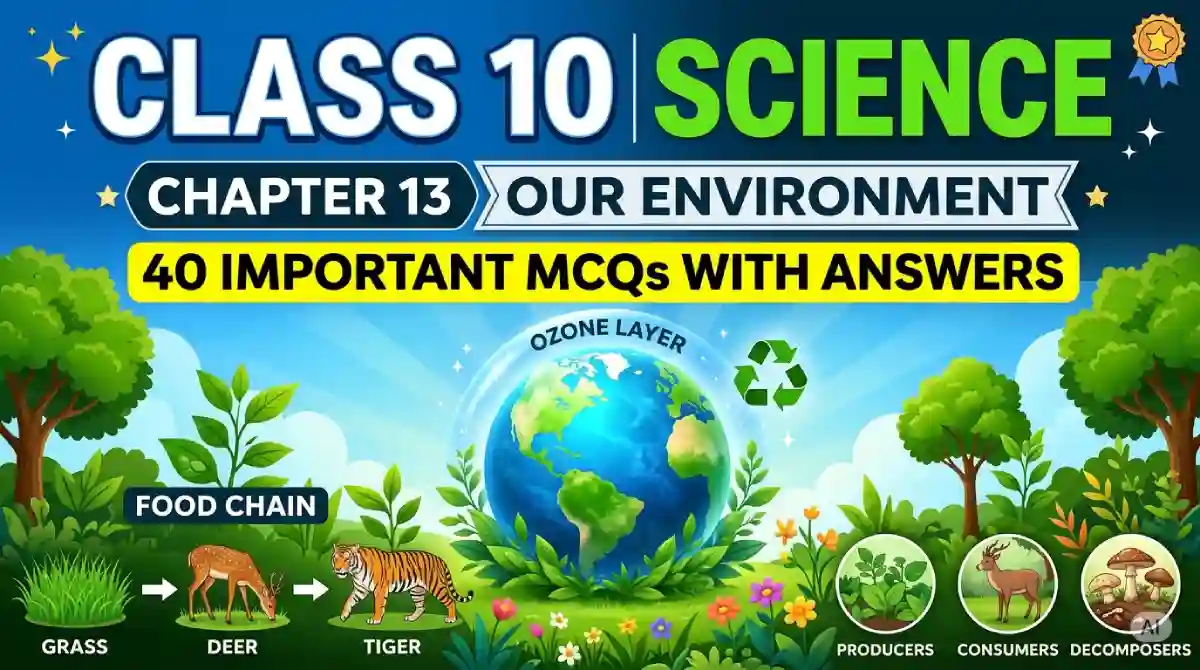
Class 10 Our Environment MCQ
Introduction
Are you preparing for your Class 10 Science examination? Practising multiple-choice questions is one of the best ways to revise important concepts and improve your exam preparation.
In this article, you will find 20 important MCQs from Class 10 Science Chapter 13 – Our Environment, based on the NCERT syllabus. These questions cover important topics such as ecosystems, food chains, food webs, trophic levels, biodegradable and non-biodegradable substances, biological magnification, and the ozone layer.Class 10 Science Chapter 13 MCQ
Each question includes four options and the correct answer to help students practise effectively.
These Class 10 Our Environment MCQs are useful for CBSE board examinations, school tests, homework, and quick revision.
Class 10 Science Chapter 13 MCQ
1. What is an ecosystem?
A. A group of only animals
B. A group of only plants
C. Interaction between living and non-living components
D. A group of microorganisms only
Answer: C. Interaction between living and non-living components
2. Which of the following is a biotic component of an ecosystem?
A. Water
B. Air
C. Soil
D. Plants
Answer: D. Plants
3. Which of the following is an abiotic component?
A. Animals
B. Plants
C. Water
D. Bacteria
Answer: C. Water
4. Green plants are known as:
A. Consumers
B. Producers
C. Decomposers
D. Scavengers
Answer: B. Producers
5. Which process is used by green plants to prepare food?
A. Respiration
B. Transpiration
C. Photosynthesis
D. Digestion
Answer: C. Photosynthesis
6. Organisms that depend on plants or other animals for food are called:
A. Producers
B. Consumers
C. Decomposers
D. Autotrophs
Answer: B. Consumers
7. Which of the following is a primary consumer?
A. Tiger
B. Lion
C. Deer
D. Eagle
Answer: C. Deer
8. Which organisms break down dead plants and animals?
A. Producers
B. Herbivores
C. Decomposers
D. Carnivores
Answer: C. Decomposers
9. Which of the following is an example of a decomposer?
A. Grass
B. Fungi
C. Deer
D. Tiger
Answer: B. Fungi
10. What is a food chain?
A. A group of animals living together
B. A sequence of organisms through which energy passes
C. A group of plants in a forest
D. A process of water circulation
Answer: B. A sequence of organisms through which energy passes
11. Which of the following represents a correct food chain?
A. Grass → Deer → Tiger
B. Tiger → Grass → Deer
C. Deer → Tiger → Grass
D. Grass → Tiger → Deer
Answer: A. Grass → Deer → Tiger
12. What is the first trophic level in a food chain?
A. Primary consumers
B. Secondary consumers
C. Producers
D. Decomposers
Answer: C. Producers
13. Which organisms occupy the second trophic level?
A. Producers
B. Primary consumers
C. Secondary consumers
D. Tertiary consumers
Answer: B. Primary consumers
14. How much energy is transferred from one trophic level to the next?
A. 1%
B. 5%
C. 10%
D. 50%
Answer: C. 10%
15. The 10% law of energy transfer was proposed by:
A. Charles Darwin
B. Lindeman
C. Louis Pasteur
D. Gregor Mendel
Answer: B. Lindeman
16. Which form of energy enters an ecosystem?
A. Sound energy
B. Solar energy
C. Chemical energy from animals
D. Electrical energy
Answer: B. Solar energy
17. What happens to energy as it moves from one trophic level to another?
A. It increases
B. It remains constant
C. It decreases
D. It becomes zero immediately
Answer: C. It decreases
18. Why are food chains generally limited to three or four trophic levels?
A. Animals cannot eat plants
B. Energy decreases at each trophic level
C. Producers consume all the energy
D. Decomposers stop the food chain
Answer: B. Energy decreases at each trophic level
19. What is a food web?
A. A single food chain
B. A network of interconnected food chains
C. A group of decomposers
D. A collection of plants
Answer: B. A network of interconnected food chains
20. Which of the following is a herbivore?
A. Lion
B. Tiger
C. Deer
D. Eagle
Answer: C. Deer
21. Which of the following is a carnivore?
A. Cow
B. Goat
C. Deer
D. Lion
Answer: D. Lion
22. Which of the following is an omnivore?
A. Cow
B. Human
C. Deer
D. Rabbit
Answer: B. Human
23. What are biodegradable substances?
A. Substances that cannot be decomposed
B. Substances that can be broken down by microorganisms
C. Substances made only of plastic
D. Substances that never decay
Answer: B. Substances that can be broken down by microorganisms
24. Which of the following is biodegradable?
A. Plastic bag
B. Glass bottle
C. Fruit peel
D. Aluminium can
Answer: C. Fruit peel
25. Which of the following is non-biodegradable?
A. Paper
B. Vegetable waste
C. Cotton cloth
D. Plastic
Answer: D. Plastic
26. Which organisms help in the decomposition of biodegradable waste?
A. Microorganisms
B. Tigers
C. Deer
D. Birds
Answer: A. Microorganisms
27. Which of the following takes the longest time to decompose naturally?
A. Fruit peel
B. Paper
C. Plastic bottle
D. Vegetable waste
Answer: C. Plastic bottle
28. What is the main advantage of biodegradable waste?
A. It increases pollution
B. It can be decomposed naturally
C. It cannot be recycled
D. It remains unchanged forever
Answer: B. It can be decomposed naturally
29. What is biological magnification?
A. Decrease in population
B. Increase in body size
C. Increase in concentration of harmful chemicals at higher trophic levels
D. Increase in plant growth
Answer: C. Increase in concentration of harmful chemicals at higher trophic levels
30. Which chemical is commonly associated with biological magnification?
A. Oxygen
B. DDT
C. Nitrogen
D. Carbon dioxide
Answer: B. DDT
31. In which organisms is the concentration of harmful chemicals generally highest?
A. Producers
B. Primary consumers
C. Top-level consumers
D. Decomposers only
Answer: C. Top-level consumers
32. Which of the following is an example of a top consumer?
A. Grass
B. Deer
C. Tiger
D. Algae
Answer: C. Tiger
33. Which layer of the atmosphere protects Earth from harmful ultraviolet radiation?
A. Troposphere
B. Ozone layer
C. Mesosphere
D. Thermosphere
Answer: B. Ozone layer
34. What is the chemical formula of ozone?
A. O₂
B. CO₂
C. O₃
D. N₂
Answer: C. O₃
35. Which type of radiation is absorbed by the ozone layer?
A. Infrared radiation
B. Ultraviolet radiation
C. Radio waves
D. Visible light
Answer: B. Ultraviolet radiation
36. Which chemical compounds are mainly responsible for ozone layer depletion?
A. Oxygen
B. Nitrogen
C. Chlorofluorocarbons (CFCs)
D. Hydrogen
Answer: C. Chlorofluorocarbons (CFCs)
37. What is the full form of CFC?
A. Carbon Fluoride Compound
B. Chlorofluorocarbon
C. Chlorine Fluoride Carbon
D. Carbon Fluorine Chloride
Answer: B. Chlorofluorocarbon
38. Which international agreement was made to protect the ozone layer?
A. Kyoto Protocol
B. Montreal Protocol
C. Paris Agreement
D. Geneva Convention
Answer: B. Montreal Protocol
39. Which of the following practices helps protect the environment?
A. Burning plastic
B. Throwing waste into rivers
C. Recycling waste materials
D. Using more disposable plastic
Answer: C. Recycling waste materials
40. Which of the following is the best way to manage household biodegradable waste?
A. Burning it
B. Throwing it into rivers
C. Composting it
D. Mixing it with plastic waste
Answer: C. Composting it
Important Topics to Revise – Our Environment
Before your examination, revise these important concepts from NCERT:Class 10 Science Chapter 13 MCQ
- Ecosystem: Interaction between biotic and abiotic components.
- Producers: Green plants that prepare food through photosynthesis.
- Consumers: Organisms that depend on other organisms for food.
- Decomposers: Microorganisms that break down dead organic matter.
- Food Chain: Transfer of food and energy from one organism to another.
- Food Web: A network of interconnected food chains.
- Trophic Levels: Different feeding levels in a food chain.
- 10% Law: Only about 10% of energy is transferred to the next trophic level.
- Biological Magnification: Increasing concentration of harmful chemicals at higher trophic levels.
- Ozone Layer: Protects Earth from harmful ultraviolet radiation.
Frequently Asked Questions (FAQs)
Q1. What is an ecosystem?
An ecosystem is a system that includes living organisms (biotic components) and non-living components (abiotic components) interacting with each other.
Q2. What are producers in an ecosystem?
Producers are green plants and other photosynthetic organisms that prepare their own food using sunlight through photosynthesis.
Q3. What is biological magnification?
Biological magnification is the increase in the concentration of harmful, non-biodegradable chemicals in organisms at successive higher trophic levels of a food chain.
Q4. Why is the ozone layer important?
The ozone layer protects living organisms on Earth by absorbing most of the Sun’s harmful ultraviolet (UV) radiation.
Q5. Give one example of biodegradable waste.
Fruit peels, vegetable waste, and paper are examples of biodegradable waste.
Q6. What is the 10% law of energy transfer?
According to the 10% law, only about 10% of the energy available at one trophic level is transferred to the next trophic level.
Q7. What are non-biodegradable substances?
Non-biodegradable substances are materials that cannot be broken down easily by natural biological processes. Examples include plastic and glass.
Q8. What is a food web?
A food web is a network of interconnected food chains that shows different feeding relationships in an ecosystem.
Conclusion
Chapter 13 – Our Environment is an important chapter in Class 10 Science. Understanding ecosystems, food chains, food webs, energy transfer, biodegradable and non-biodegradable waste, biological magnification, and ozone layer depletion can help you prepare effectively for your examination.
Practise these 40 important Class 10 Our Environment MCQs with answers regularly to improve your understanding and confidence.
Read the NCERT textbook carefully, revise the important definitions, and solve practice questions to achieve better results in your Class 10 Science examination.
Best of luck with your examination!