
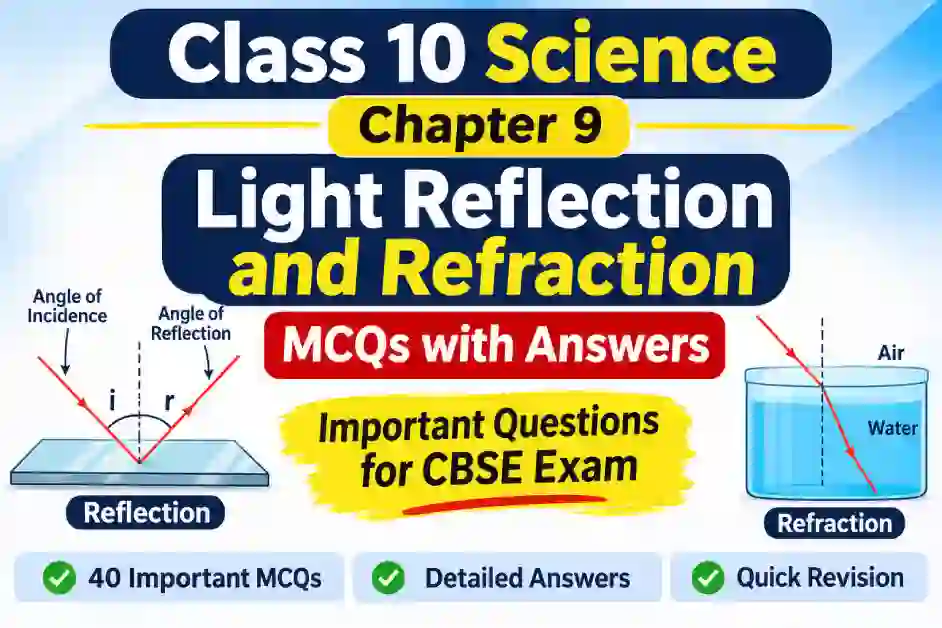
Light Reflection and Refraction
Class 10 Science Chapter 9 MCQs
Prepare for your CBSE Class 10 Science examination with 20 important Class 10 Science Chapter 9 MCQs with answers and explanations. This chapter, Light – Reflection and Refraction, covers important concepts related to the reflection of light, spherical mirrors, refraction, spherical lenses and the human eye.
Practising these multiple-choice questions will help you understand important concepts, improve problem-solving skills and revise NCERT topics effectively.
Attempt this free online quiz to test your knowledge, check your answers and prepare for your CBSE board examination.
Class 10 Science Chapter 9 MCQs – Online Quiz
Test your knowledge of Light Reflection and Refraction with 20 important multiple-choice questions. Read each question carefully, select the correct answer and review your performance.
Important Topics Covered in Light Reflection and Refraction
This Class 10 Science Chapter 9 MCQ practice set covers the following important topics:
- Laws of reflection of light
- Reflection from spherical mirrors
- Concave and convex mirrors
- Image formation by spherical mirrors
- Mirror formula and magnification
- Refraction of light
- Laws of refraction
- Refractive index
- Refraction through a glass slab
- Convex and concave lenses
- Image formation by spherical lenses
- Lens formula and magnification
- Power of a lens
Why Practise Class 10 Science Chapter 9 MCQs?
Practising chapter-wise MCQs is an effective way to revise important Science concepts before examinations.
These questions help students:
- Understand the laws of reflection and refraction.
- Identify the differences between concave and convex mirrors.
- Practise numerical questions based on mirror and lens formulas.
- Understand image formation by mirrors and lenses.
- Improve accuracy and confidence in objective questions.
- Prepare for school tests and CBSE board examinations.
Frequently Asked Questions – Class 10 Science Chapter 9 MCQs
Q1. What is the law of reflection?
The angle of incidence is equal to the angle of reflection. Both angles are measured from the normal to the reflecting surface.
Q2. What is refraction of light?
Refraction is the bending of light when it travels from one transparent medium to another due to a change in its speed.
Q3. Which mirror is used as a rear-view mirror in vehicles?
A convex mirror is used as a rear-view mirror because it provides a wider field of view and forms erect, diminished images.
Q4. What is the power of a lens?
The power of a lens is the reciprocal of its focal length measured in metres. Its SI unit is dioptre (D).
Q5. What is the SI unit of focal length?
The SI unit of focal length is the metre (m).
Q6. Which lens is called a converging lens?
A convex lens is called a converging lens because it converges parallel rays of light to a point after refraction.
Q7. Which mirror is used by dentists?
A concave mirror is commonly used by dentists because it can produce an enlarged, erect image when the object is placed close to it.
Q8. How many questions are included in this quiz?
This practice quiz contains 40 multiple-choice questions with answers and explanations.
Q9. Is this quiz useful for CBSE Class 10 board exam preparation?
Yes. It helps students revise important NCERT concepts and practise objective questions related to Light Reflection and Refraction.
Preparation Tips for Chapter 9
Follow these tips to prepare effectively for your Class 10 Science examination:
- Read the NCERT chapter carefully and understand all important concepts.
- Learn the laws of reflection and refraction.
- Practise ray diagrams for concave mirrors, convex mirrors and lenses.
- Revise mirror and lens formulas with sign conventions.
- Solve numerical problems based on focal length and magnification.
- Practise chapter-wise MCQs regularly.
- Review incorrect answers and understand the explanations.
Explore More Class 10 Science MCQs
Continue your CBSE exam preparation with more chapter-wise Science practice tests on Student Mock Test.
Explore related quizzes:
- Class 10 Science Chapter 8 MCQs
- Class 10 Science Chapter 10 MCQs
- All Class 10 Science Chapter-wise MCQ Tests
Practise regularly to improve your knowledge, accuracy and confidence before your board examination.
Class 10 Science Chapter 9 – 10 Important MCQs with Answers
Q1. Which law of reflection states that the angle of incidence is equal to the angle of reflection?
A. First law of refraction
B. Second law of reflection
C. Law of conservation of energy
D. Snell’s law
Correct Answer: B. Second law of reflection
Explanation: According to the second law of reflection, the angle of incidence is equal to the angle of reflection. Both angles are measured from the normal.
Q2. Which type of mirror is used as a rear-view mirror in vehicles?
A. Plane mirror
B. Concave mirror
C. Convex mirror
D. Cylindrical mirror
Correct Answer: C. Convex mirror
Explanation: A convex mirror provides a wider field of view and forms erect, diminished images. Therefore, it is used as a rear-view mirror in vehicles.
Q3. What is the principal focus of a concave mirror?
A. The centre of the mirror
B. The point where parallel rays meet after reflection
C. The centre of curvature
D. The pole of the mirror
Correct Answer: B. The point where parallel rays meet after reflection
Explanation: Parallel rays of light travelling close to the principal axis converge at the principal focus after reflection from a concave mirror.
Q4. Which mirror always forms a virtual, erect and diminished image?
A. Concave mirror
B. Convex mirror
C. Plane mirror
D. None of these
Correct Answer: B. Convex mirror
Explanation: A convex mirror always forms a virtual, erect and diminished image, irrespective of the object’s position.
Q5. What is the SI unit of the focal length of a spherical mirror?
A. Centimetre
B. Dioptre
C. Metre
D. Metre per second
Correct Answer: C. Metre
Explanation: Focal length is a measure of distance, so its SI unit is the metre (m).
Q6. What happens when light travels from air into glass?
A. It bends away from the normal
B. It bends towards the normal
C. It travels without changing direction in every case
D. It stops completely
Correct Answer: B. It bends towards the normal
Explanation: When light enters glass from air, it travels from a rarer to a denser optical medium and bends towards the normal, provided it enters obliquely.
Q7. Which lens is known as a converging lens?
A. Concave lens
B. Convex lens
C. Plane glass slab
D. Cylindrical mirror
Correct Answer: B. Convex lens
Explanation: A convex lens is thicker at the centre than at the edges. It converges parallel rays of light towards its principal focus.
Q8. What is the power of a lens with a focal length of 0.5 metre?
A. +2 D
B. +0.5 D
C. -2 D
D. -0.5 D
Correct Answer: A. +2 D
Explanation: Power of a lens is calculated using P = 1/f, where focal length is measured in metres.
P = 1/0.5 = +2 dioptres.
Q9. Which type of image is formed by a concave lens?
A. Real and inverted
B. Virtual, erect and diminished
C. Real and enlarged
D. Virtual and enlarged
Correct Answer: B. Virtual, erect and diminished
Explanation: A concave lens always forms a virtual, erect and diminished image of a real object placed in front of it.
Q10. What is the relationship between the radius of curvature (R) and focal length (f) of a spherical mirror?
A. R = f
B. R = 2f
C. R = f/2
D. R = 4f
Correct Answer: B. R = 2f
Explanation: The radius of curvature of a spherical mirror is twice its focal length. This relatio