
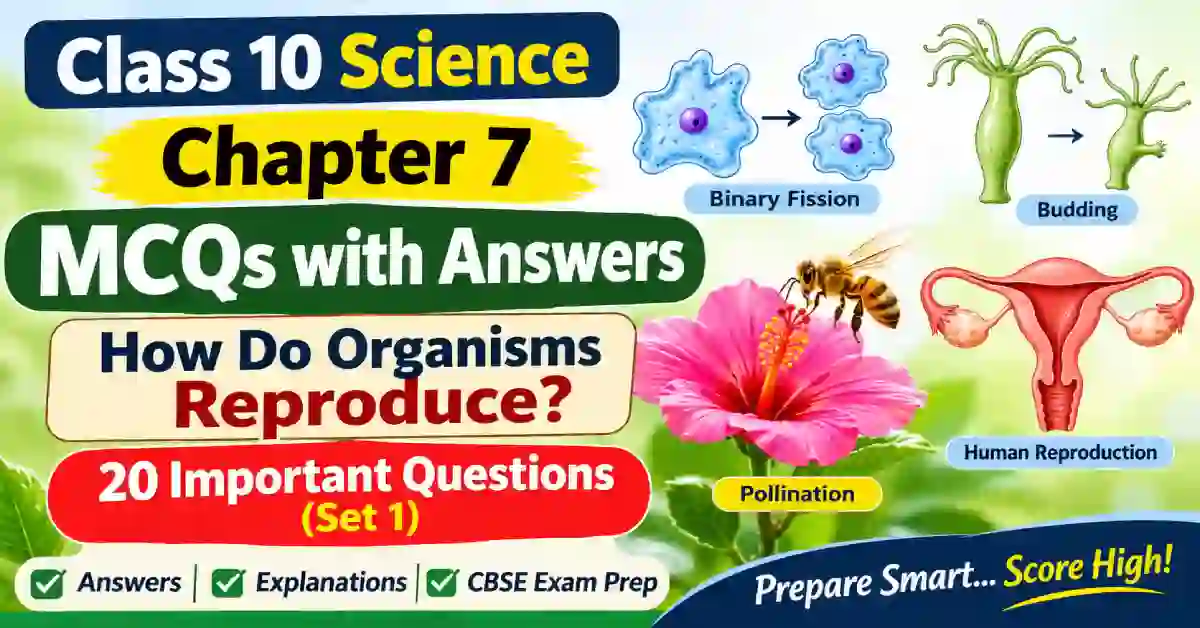
Class 10 Science Chapter 7 MCQs with Answers | How Do Organisms Reproduce Important Questions Set 1
Class 10 Science Chapter 7 MCQs with Answers – How Do Organisms Reproduce (Set 1)
Prepare for your CBSE Class 10 Science examination with 20 important Class 10 Science Chapter 7 MCQs. This chapter, How Do Organisms Reproduce?, covers important concepts related to reproduction in plants and animals.
Attempt this free online quiz to test your knowledge, check your answers and understand important concepts with explanations. These questions are useful for NCERT revision, school tests and CBSE board exam preparation.
Class 10 Science Chapter 7 MCQs – Online Quiz
Test your understanding with 40 multiple-choice questions from Class 10 Science Chapter 7. Read each question carefully, select the correct option and review your performance.
Quiz Details:
- Class: 10
- Subject: Science
- Chapter: 7 – How Do Organisms Reproduce?
- Total Questions: 40
- Question Type: Multiple Choice Questions (MCQs)
- Answers: Included
- Level: CBSE / NCERT-based practice
Start the free quiz below:
[PASTE YOUR EXISTING QUIZ SHORTCODE HERE]
Important Topics Covered in How Do Organisms Reproduce?
This Class 10 Science Chapter 7 MCQ practice set covers important topics such as:
- Importance of reproduction
- Asexual reproduction
- Binary fission and multiple fission
- Budding and fragmentation
- Regeneration
- Vegetative propagation
- Sexual reproduction in flowering plants
- Pollination and fertilisation
- Human male and female reproductive systems
- Reproductive health
Frequently Asked Questions – Class 10 Science Chapter 7 MCQs
Q1. Why is reproduction important?
Reproduction is important because it ensures the continuity of a species by producing new individuals.
Q2. What is asexual reproduction?
Asexual reproduction is a type of reproduction in which a single parent produces offspring without the formation and fusion of gametes.
Q3. Where does fertilisation occur in humans?
In humans, fertilisation usually occurs in the fallopian tube (oviduct).
Q4. What is pollination?
Pollination is the transfer of pollen grains from the anther to the stigma of a flower.
Q5. What is the name of Class 10 Science Chapter 7?
The chapter is titled How Do Organisms Reproduce?
Q6. How many questions are included in this quiz?
This practice quiz contains 40 multiple-choice questions with answers and explanations.
Q7. Is this quiz useful for CBSE board exam preparation?
Yes. It helps students revise important NCERT-based concepts and practise objective questions for their Class 10 Science examination.
Preparation Tips for Chapter 7
- Read the NCERT chapter carefully.
- Understand the differences between sexual and asexual reproduction.
- Revise important diagrams and biological processes.
- Practise chapter-wise MCQs regularly.
- Review incorrect answers and understand the explanations.
Explore More Class 10 Science MCQs
Continue your preparation with more chapter-wise Class 10 Science quizzes on Student Mock Test. Practise regularly to improve your understanding and confidence.
FAQ
Q1. Why is reproduction important?
It ensures continuity of species.
Q2. What is asexual reproduction?
Reproduction involving a single parent.
Q3. Where does fertilisation occur in humans?
In the fallopian tube.
Q4. What is pollination?
Transfer of pollen from anther to stigma.
Class 10 Science Chapter 7 MCQs
Class 10 Science Chapter 7 MCQs with Answers | Reproduction in Organisms
class-10-science-chapter-7-mcqs-reproduction.
Download Class 10 Science Chapter 7 MCQs with answers and explanations. Important How Do Organisms Reproduce questions for CBSE exam revision.
Class 10 Science Chapter 7 – 10 Important MCQs with Answers
Q1. What is the main purpose of reproduction in living organisms?
A. To produce energy
B. To ensure continuity of species
C. To increase body size
D. To obtain food
Correct Answer: B. To ensure continuity of species
Explanation: Reproduction produces new individuals and helps maintain the continuity of a species from generation to generation.
Q2. Which of the following is an example of binary fission?
A. Hydra
B. Amoeba
C. Rhizopus
D. Rose
Correct Answer: B. Amoeba
Explanation: Amoeba reproduces asexually by binary fission, in which one parent cell divides into two daughter cells.
Q3. Which organism reproduces through budding?
A. Amoeba
B. Hydra
C. Plasmodium
D. Leishmania
Correct Answer: B. Hydra
Explanation: In Hydra, a small outgrowth called a bud develops on the parent’s body and eventually separates to form a new individual.
Q4. Which method is commonly used for vegetative propagation?
A. Spore formation
B. Binary fission
C. Cutting
D. Fertilisation
Correct Answer: C. Cutting
Explanation: Vegetative propagation is a form of asexual reproduction in plants. New plants can grow from stem cuttings, roots or leaves.
Q5. Which part of a flower produces pollen grains?
A. Stigma
B. Ovary
C. Anther
D. Sepal
Correct Answer: C. Anther
Explanation: The anther is the part of the stamen that produces pollen grains containing the male reproductive cells.
Q6. What is the fusion of male and female gametes called?
A. Pollination
B. Fertilisation
C. Germination
D. Fragmentation
Correct Answer: B. Fertilisation
Explanation: Fertilisation is the process in which male and female gametes fuse to form a zygote.
Q7. Which organ produces sperm in human males?
A. Prostate gland
B. Testes
C. Urethra
D. Urinary bladder
Correct Answer: B. Testes
Explanation: The testes produce sperm and the hormone testosterone. They are located in the scrotum.
Q8. Where does the embryo normally get implanted in the human female reproductive system?
A. Ovary
B. Fallopian tube
C. Uterus
D. Vagina
Correct Answer: C. Uterus
Explanation: After fertilisation, the developing embryo travels to the uterus and gets implanted in its thickened lining.
Q9. Which contraceptive method helps prevent both pregnancy and the transmission of many sexually transmitted infections?
A. Copper-T
B. Oral contraceptive pills
C. Condom
D. Surgical method
Correct Answer: C. Condom
Explanation: Condoms act as a barrier and help prevent pregnancy as well as reduce the risk of transmission of many sexually transmitted infections.
Q10. What is the role of DNA copying during reproduction?
A. It stops cell division
B. It transfers hereditary information to offspring
C. It prevents variation completely
D. It produces food for offspring
Correct Answer: B. It transfers hereditary information to offspring
Explanation: DNA copying transfers genetic information from parents to offspring. Small differences during copying can also contribute to variations.